
News&Articles
2026.06.30
Nagoshi no Harae
Nagoshi no Harae: A Thousand-Year Prayer in Ice and Adzuki Beans
June 30th marks a Shinto ritual called Nagoshi no Harae, a day to cleanse the impurities and misfortunes accumulated over the first half of the year. The triangular Japanese sweet eaten on this day, Minazuki, is shaped to resemble the precious ice that aristocrats once used to stay cool in the summer. The adzuki beans sprinkled on top are not merely for decoration; they carry the meaning of expelling excess heat and moisture from the body, as well as warding off bad luck and evil spirits.
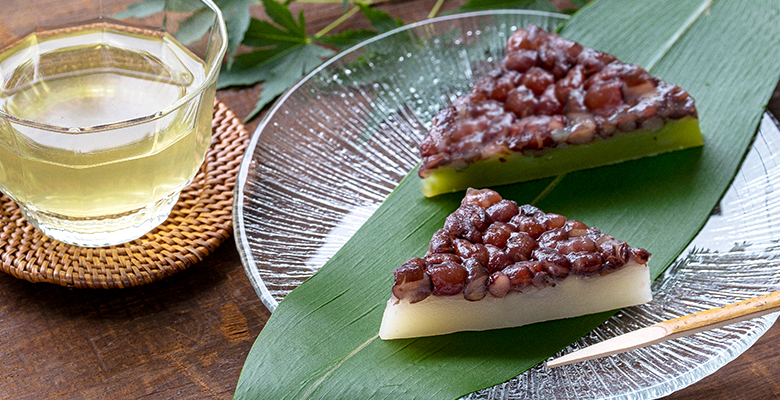
Furthermore, rituals like Nagoshi no Harae hold deep significance related to the Japanese language. Take the phrase ki ga kareru (one's energy is depleted). It is said to share its etymological roots with kegare (impurity or defilement), a uniquely Japanese concept. In other words, kegare actually originates from a state of kegare (energy depletion), where one's vital energy is completely exhausted.
During this time of year, when our physical and mental energy bottoms out due to the heat and humidity of the rainy season, people perform Chinowa Kuguri—stepping through a large ring made of natural cogon grass (kaya). By doing this, you recharge with natural energy, reset the fatigue of the past six months, and head into the second half of the year. It serves as a uniquely Japanese, mindful event. The appearance of the Chinowa ring is somewhat similar to a Torii gate, but it is fascinating how its meaning differs slightly.
If you visit a local shrine right now, you will likely see this large ring, the Chinowa, on the grounds. In this article, I introduced the background behind Chinowa Kuguri. It is a traditional technique for ensuring you spend the remaining half of the year in good health.
But why must this ring be made of a plant called kaya? Kaya is a general term for plants in the grass family, which have long been believed to possess a strong vitality capable of warding off evil spirits. In ancient Japanese mythology, there is a legend that a man named Somin Shorai protected himself from a plague by wearing a ring of kaya around his waist. Chinowa Kuguri protects our bodies from illness and disaster.
Finally, if you happen to see a Chinowa and want to try this ritual yourself, I would like to introduce the proper etiquette. Basically, you need to step through it in a figure-eight pattern.
-
Step through with your left foot, turn left, and return to the front.
-
Step through with your right foot, turn right, and return to the front.
-
Step through with your left foot, turn left, and finally proceed straight to the altar to pray.
This movement also holds the meaning of balancing the left and right sides of the body and circulating stagnant energy. The rainy season this year is incredibly humid, making it easy to fall ill. Please take good care of yourselves.