
News&Articles
2026.07.07
The Romance of Tanabata
The Romance of Tanabata: Japan's Star Festival and Wishing for Health
Today, July 7th, Japan celebrates Tanabata. If you walk around town or visit a shopping center, you might see beautiful bamboo branches decorated with colorful strips of paper.
The Legend of Orihime and Hikoboshi Tanabata originates from a romantic ancient legend. Orihime and Hikoboshi were deeply in love, but they became so devoted to each other that they neglected their duties. Angered by this, the King of Heaven separated them across the Milky Way. However, they were allowed to meet just once a year, on the night of July 7th. For centuries, Japanese people have looked up at the summer night sky, composed poetry, and celebrated their reunion.
During the Tanabata season, it is a tradition to write wishes on small, colorful strips of paper called tanzaku and hang them on bamboo leaves. It is believed that the bamboo, growing straight and tall into the sky, will carry our wishes to the heavens.
Wishing for Health and Harmony Many people write wishes for their family's happiness, success, or love. Making a wish during Tanabata is a very important cultural event in Japan. What kind of wish would you like to make this year?
The Origins of Tanabata and Intertwining Cultures Regarding the origins of Tanabata, it is actually said to be a mix of two myths and cultures: Chinese legend and ancient Japanese Shinto.
The familiar love story of Orihime and Hikoboshi undoubtedly has its roots in Chinese star mythology. In China, there was a custom called Kikoden, where women would pray to the stars to improve their skills in weaving, sewing, and calligraphy. This was introduced to the Japanese imperial court during the Nara and Heian periods, spreading among the aristocrats as an elegant event where they would gaze at the stars, compose waka poetry, and play music. At that time, they would rub ink with the evening dew collected on taro leaves and write Tanabata-related poems on paper mulberry leaves (kaji-no-ha). This is said to be the root of the modern tanzaku.
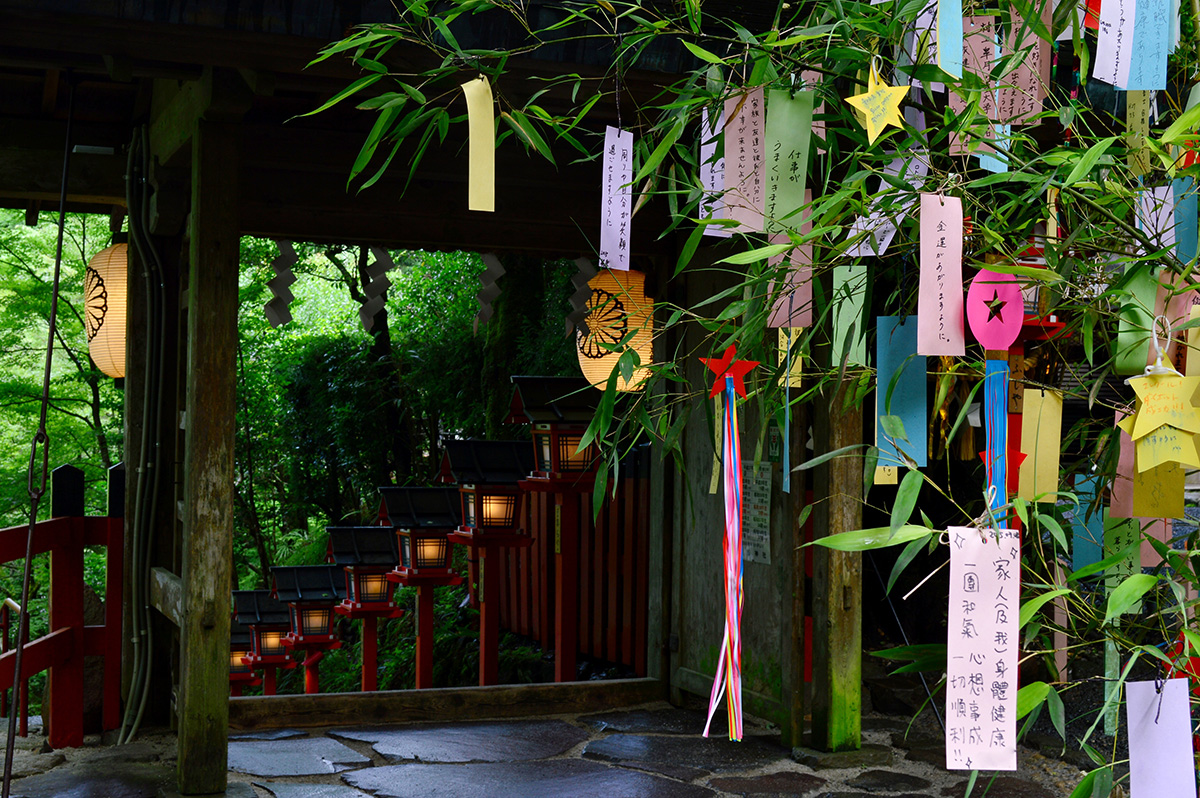
On the other hand, elements of the ancient Japanese Shinto ritual known as Tanabata (棚機) can also be seen. In ancient Japan, there was a purification ritual to pray for a bountiful autumn harvest, where a kimono was woven for the gods and offered at a weaving hut by the water. The maiden chosen for the god was called Tanabata-tsume, and the loom she used was called Tanabata. It seems that various cultures and traditions intertwined to settle into its current form.
In any case, July 7th was also known as Nanoka-bon (the 7th day of Obon) and served as a seasonal turning point leading up to the Obon festival. Wishing upon the stars, celebrating the changing of the seasons, and purifying the mind and body to prepare for the coming period—these are the deeper meanings woven into Tanabata.
We hope that all of your Tanabata wishes come true.