
News&Articles
2026.07.21
Feeling "Cool"
Feeling "Cool" Through Sound: Surviving the Heat with Imagination in the Beautiful Japanese Summer
Hello everyone. Today, I would like to share a little bit about Japanese summer culture.
As we enter the latter half of July, Japan is experiencing its true summer heat. With the rainy season now over, we are right in the middle of midsummer. In our modern lives, turning on the air conditioner is an absolute necessity. But before the days of such extreme heat, and before air conditioners existed in Japan, how did people survive this highly humid and hot season?
Creating "Coolness" with the Five Senses and Imagination What the people of ancient Japan excelled at was a highly creative approach: instead of physically lowering the temperature, they used the human "five senses" and "imagination" to make the brain feel cool.
Today, the one item I particularly want to introduce is the Fuurin (Wind Chime). By hanging a small glass or iron bell under the eaves of a house and listening to its clear, high-pitched "chiring" sound, the brain imagines, "Ah, a cool breeze must be blowing right now," which psychologically lowers the perceived body temperature.
A Fuurin is not just a cute decoration. It is actually a masterpiece of ancient wisdom that cleverly utilizes the mechanisms of the human brain and autonomic nervous system. As foreign residents living in Japan already know, Japanese summers are extremely humid, and on windless days, the heat can feel suffocating. However, the moment a slight breeze blows and the wind chime rings, we hear that high-pitched tone and unconsciously imagine a cool breeze. It is said that even if the breeze doesn't actually touch you, your brain relaxes, peripheral blood vessels dilate, and your perceived body temperature genuinely drops.
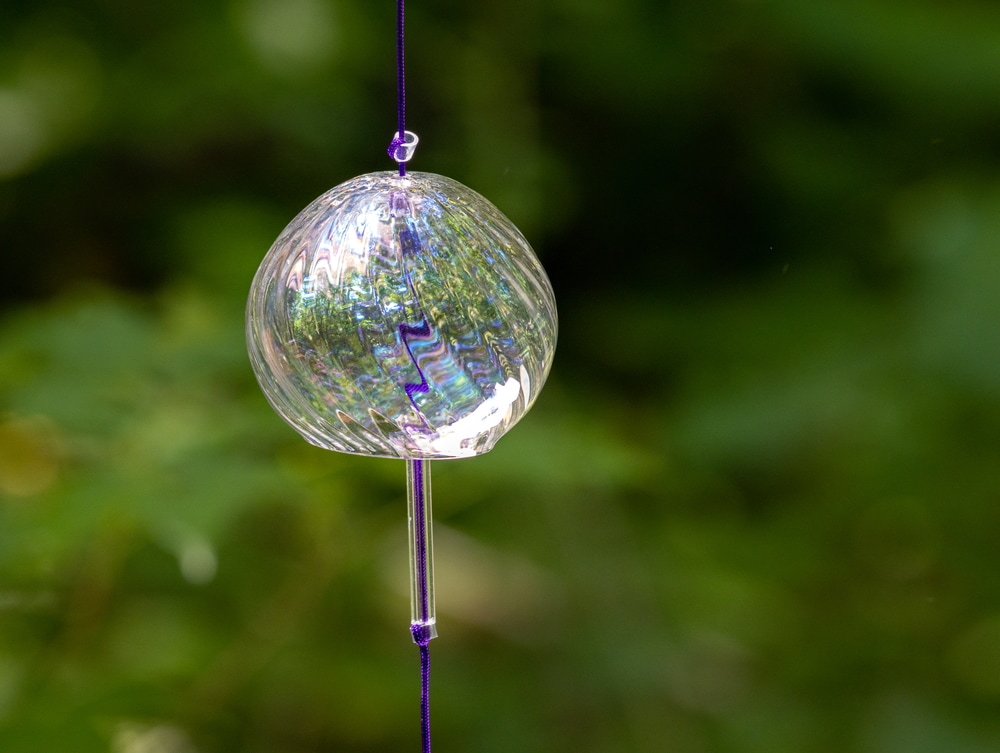
Glass or Iron: Which Sound Do You Prefer? There are two main types of Fuurin that bring this sense of coolness. One is the Edo Fuurin, a tradition continuing since the Edo period. This is likely the most common shape of wind chimes in modern Japan. Made of glass, it is characterized by a short, light, and refreshing "clinking" sound. The other is the Nambu Tekki (Nambu Ironware) wind chime, a traditional craft from Iwate Prefecture. The clear, high-pitched "chiiiiiin" sound produced by the heavy iron leaves an incredibly long and beautiful resonant echo.
Hanging a wind chime on your balcony or by your window will allow you to experience the "coolness" of the Japanese summer through your ears, and it will surely become a wonderful memory of your time in Japan.
The Roots of Fuurin and Its Power to "Ward Off Evil" Actually, wind chimes have another power besides bringing coolness. How far back do the roots of the wind chime go? Its history is incredibly ancient, tracing back about 2,000 years to China. At that time, it was called a Senfutaku (fortune-telling wind bell). It was hung in bamboo groves and used as a tool to tell fortunes based on the wind's direction and the way it rang. This Senfutaku was introduced to Japan along with Buddhism and became the Futaku (wind bell) hung at the four corners of temple roofs. People in the past believed that "strong winds carry epidemics and evil spirits." Therefore, the area where the clanging sound of the Futaku could be heard was considered a sacred sanctuary, and it served as a "barrier to ward off evil."
A Variety of Wind Chimes Across Japan I mentioned glass and iron earlier, but wind chimes also boast rich regional diversity. Here are a few representative examples:
-
Nambu Tekki Fuurin (Iwate Prefecture): The long, clear, and resonant sound of heavy iron.
-
Myochin Hibashi Fuurin (Hyogo Prefecture): Made by striking together traditional iron fire tongs (hibashi) used in hearths. It features a highly transparent, shimmering metallic sound.
-
Binchotan Fuurin (Wakayama Prefecture): Made by hanging the highest quality Kishu Binchotan charcoal. It produces a uniquely warm, hard, and clacking sound.
-
Arita & Imari Ware Fuurin (Saga Prefecture): Made of porcelain, these chimes offer both a beautiful, high-pitched sound and visually stunning painted designs.
When you choose a wind chime from among the many varieties, thinking, "This is the sound that suits me best," the "coolness" that sound emits will hold a special meaning for you.
I do not know how long you will stay in Japan, or if you will be here forever, but I hope that each of these sounds will become a wonderful memory for you. Let's get through this grueling Japanese summer together.