
News&Articles
2026.08.09
Roots of Obon.
Well, Obon is finally here. I wonder how the Obon holiday appears to all the foreign residents in Japan? During this time, communication with many companies stops, which might feel inconvenient, but in this article, I would like to introduce the fascinating roots of Obon.
Root 1: Buddhist Teachings First, one of its roots is Buddhism. The formal name for Obon in Buddhism is Urabon-e, which originates from a Buddhist sutra called the Ullambana Sutra.
In this sutra, there is a famous episode about a disciple of Buddha named Maudgalyayana (known as Mokuren in Japan). Mokuren discovered that his deceased mother had fallen into the Realm of Hungry Ghosts and was suffering as if she were hung upside down. When Mokuren held a memorial service exactly as Buddha instructed, his mother was saved from her suffering through the merit of his actions. From this episode, the Buddhist teaching of holding memorial services for ancestors and the deceased during this time of summer was born. Japan's Buddhist culture is deeply connected to India and Sanskrit traditions.
Root 2: Japan's Indigenous Ancestor Worship The episode above came with the introduction of Buddhism to Japan, which is said to have happened during the Asuka period—the era of the famous Prince Shotoku. However, even before Buddhism arrived, Japan had its own Shinto and indigenous folk beliefs. If you look at the long timeline of Japanese history, that era was actually much longer.
Let me introduce the concept of Sorei Shinko (ancestor worship). This is an indigenous belief that the spirits of deceased ancestors return from the mountains and the sea to protect their descendants. In ancient times, it was believed that our ancestors visited us twice a year: at New Year's and in "early autumn" (which corresponds to this current summer period), right before the autumn harvest. People made many preparations to welcome the spirits of their ancestors. Festivals were held all over Japan to offer sacred foods and dedicate prayers and gratitude. It is said that the remnants of these events are what we know as Obon today.
A Beautiful Fusion of Two Cultures In other words, the Buddhist Ullambana Sutra and the indigenous Sorei Shinko merged between the Asuka and Nara periods. As Buddhist teachings spread among Japanese aristocrats and gradually reached warriors and commoners, they perfectly combined with the pre-existing local festival of welcoming ancestral spirits in early autumn.
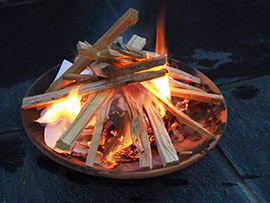
Take Mukaebi (welcoming fire) and Okuribi (send-off fire), for example. Lighting these fires so our ancestors' spirits do not lose their way to our homes clearly reflects the Shinto ideology of welcoming souls. Furthermore, Bon Odori (Bon dance) originally started as a Buddhist dance to comfort the returning spirits and safely send them off again.
The Obon we know today is a uniquely rich Japanese culture created by beautifully mixing the Buddhist story of filial piety and memorial services—passed down from India through China—with the Japanese people's ancient gratitude toward ancestors and their worship of nature.